1 Jul 2023

Progress at the Moated Site


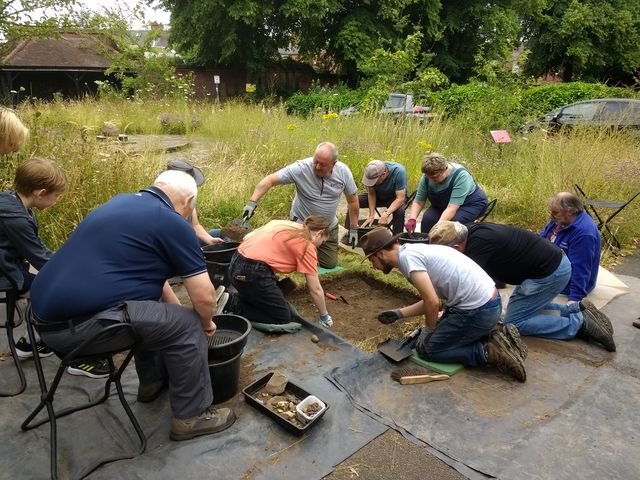
Good progress is now being made on our current project, with almost a complete cross-section of the moat having been excavated. Our work to date shows that the moat was around 1.2m deep in the middle with the blue-grey sandstone floor rising gently towards each edge. The edges of the moat seem to be formed by a vertical 'wall' of clay in front of which, sand has been used to form a slope which in turn has also been covered with a thin layer of clay.

Dating evidence from the very bottom of the moat suggests it was last cleaned out in the second half of the 17th century but after that it was allowed to silt up. Fast forward to the late 1700s and the house which stood on the island platform was demolished and the rubble put into the moat. Since then around a foot of topsoil has built up both mostly as a result of leaf litter from the nearby oak trees.

The photo above shows the north end of our trench, where the rising floor meets a wall of clay at the furthest point.

We're still working on the south end (below), having just encountered the bottom of the clay slope in which the large stone at centre is set.


This artificial colour image shows the various strata to good effect; topsoil, demolition rubble, silt, clay slope, sand, sandstone at bottom and clay 'wall' at left:


Tilley Field Trip


On 24th June WAG members were treated to a guided tour of the beautiful Shropshire village of Tilley. Our hosts,  George Nash and Alastair Reid, have spent years studying the village's amazing collection of timber-framed houses and its history in general.

Their work forms the basis for two books, 'The Tilley Timber Project' and 'Tilley: The Secret History of a Secret Place'. The 'timber project' began with dendrochronological dating of timbers but expanded to include other historical aspects of the buildings concerned, while the 'secret history' book is a detailed look at the entire history of Tilley from the Anglo-Saxon era to the twentieth century.

One of the most fascinating details revealed by George and Alastair's work is the notable spikes in building activity in certain years, especially in the early seventeenth century. They were able to show that local trees were used for construction and explain the varied and intriguing range of carpenter's marks and witches marks. In the latter case experimental archaeology was used to discover exactly how candles could produce flame marks on oak beams without burning down the entire house!

The glorious weather (and tea and cakes in the garden!) topped off one of the most memorable and interesting visits WAG have made in recent years.


11 Jan 2023

Unknown Burials Rediscovered


Over the weekend of 7th/8th January 2023, we investigated some underground brickwork which had been recently been brought to the attention of the Albrighton and District Historical Society. Having worked in partnership with ADHS before we were confident that this was a lead worth following up and that there would be plenty of local interest. However, we didn't expect to find two intact tombs which don't appear in the burial records or to be able to welcome so many interested townsfolk to our dig.

The photo above shows the pair of brick-built tombs with their barrel-vaulted roofs and below, the WAG dig team. Two Society members also joined us for the dig which was a resounding success with dozens of locals checking on our progress, some visiting as many as three times over the course of the weekend!

Clues discovered during the dig will hopefully enable the Society to discover the identify of those interred and add a little more to the recorded history of the town.


7 Dec 2022

POW Camp Comes to Light


While digging test pits in our search for a medieval site we unexpectedly came across some in situ remains of a prisoner of war camp.

We were fully aware that some wartime buildings were in our area of interest and we'd previously encountered rubble associated with them. Newspaper advertisements such as that below show that structures, equipment and building materials from the camp were sold off in 1953, so we were slightly surprised to find part of a brick floor still intact. However, it soon became apparent that what we had was in fact a lower layer. Traces of the upper layer were still attached to the concrete foundations in places showing that some bricks had broken as they were being removed so it was probably not thought worthwhile to attempt removal of the rest.

Being comparatively recent features, POW camps were neglected in the second half of the 20th century and only now are they being studied in detail. A list of known camps can be found at: https://www.ww2pow.uk/


5 Sept 2022

Back to Basics


Our current project involves the search for a moated hall which was destroyed around the middle of the 18th century. After carrying out a 60 by 60 metre geophys survey and digging 10 exploratory test pits in the area where we thought the hall lay, we were having little success. While we'd found some prehistoric flint waste, some medieval pot and a few pre-industrial era roof tiles we had no sign of the building. We therefore decided to go over our map research again from scratch.

Give that we only had a somewhat skewed photograph of the only map that shows the old building, matching up features with the present day landscape was something of a challenge. This time, two members independently carried out the work and both came to the same conclusion: that the old hall was about 20 metres outside out search area!

As soon as we put in a test pit in this new area we could tell it was different as we came down onto a creamy sandy layer rather than the usual degraded sandstone and clay interface. Extension of the test pit into a trench soon revealed what appears to be a foundation trench consisting of stones, tile, slag and possibly broken fragments of worked stone set in a clay matrix within a metre wide cut as shown in the photo above. Better yet, as we uncovered this structure we found half a dozen pieces of pot, all of which are earlier than 1700. Hopefully following the feature will lead us to discover more about this intriguing site.


10 Aug 2022

The Wonder of Photogrammetry


Archaeology is a huge discipline, employing all sorts of technology in the field, on the desktop and in the laboratory. While the newest technologies are almost always beyond the reach of amateur groups, many will become available given time. At various times in the last hundred years, amateur archaeologists must have thought that aerial photography, geophysics, GPS and LIDAR were miles beyond their reach but all are now available to a greater or lesser degree.

And so it is with photogrammetry: the application of computing power to a collection of photographs to build an interactive model of an object or excavation. The advent of phones with high resolution cameras and powerful consumer level computers has made this pipe dream a reality.

To illustrate its usefulness, here's a link to one of our photogrammetry models of a test pit. While it doesn't give the level of detail required for archaeological recording there's no doubt that it provides a fantastic overview. Importing such models into virtual reality systems will probably become commonplace, giving the viewer a real sense of 'being there'.

Photogrammetry model


29 Jul 2022

Discovering the Past, Creating Memories


Based on past experience, we hoped our three-day CBA Festival of Archaeology event at Oak House, West Bromwich would be popular with visitors, volunteers and members but we were completely blown away by the response.

Dozens of children and adults tried their hand at archaeology, with some returning for 'second helpings' on the same day or even coming back on the following day! On day one we were really pleased to welcome Sandwell's new mayor Richard Jones to our dig and throughout the event, we were accompanied by Oak House staff in authentic period costume. Our team put in a fantastic amount of effort to get people involved and help explain our findings which included objects dating back the the early history of the House.

In addition to our report which will follow in due course, we are delighted to be able to provide Oak House with 3D photogrammetry models of the test pits. These can be used for display or reference purposes in the future and give the viewer the impression of actually being there.

A huge thanks to the staff at Oak House, our members, volunteers and visitors for making this such a memorable event.

Test Pit No. 1 containing the base of a Victorian garden ornament (and a modern cable protected by drain pipes!):


A rare child-free moment for the team to crack on with the dig:


Test Pit No. 2 modern concrete supporting the kerb at left, edge of clay surface running top to bottom, possible traces of cobbled path/yard:


Families enjoying a free day out with sunshine and a glorious backdrop:


 One of our photogrammetry models:


16 Jun 2022

New Project Coming Soon


Fancy digging a medieval moated manor house? There's nothing left above ground (unlike the marvelous 'Little Moreton Hall' in the photo) but whatever remains, we aim to find it! Join Wolverhampton Archaeology Group and you could be part of this exciting new project which starts in just a few weeks time. Email for details:

wolverhampton-archaeology-group@gmail.com