29 Jul 2022

Discovering the Past, Creating Memories


Based on past experience, we hoped our three-day CBA Festival of Archaeology event at Oak House, West Bromwich would be popular with visitors, volunteers and members but we were completely blown away by the response.

Dozens of children and adults tried their hand at archaeology, with some returning for 'second helpings' on the same day or even coming back on the following day! On day one we were really pleased to welcome Sandwell's new mayor Richard Jones to our dig and throughout the event, we were accompanied by Oak House staff in authentic period costume. Our team put in a fantastic amount of effort to get people involved and help explain our findings which included objects dating back the the early history of the House.

In addition to our report which will follow in due course, we are delighted to be able to provide Oak House with 3D photogrammetry models of the test pits. These can be used for display or reference purposes in the future and give the viewer the impression of actually being there.

A huge thanks to the staff at Oak House, our members, volunteers and visitors for making this such a memorable event.

Test Pit No. 1 containing the base of a Victorian garden ornament (and a modern cable protected by drain pipes!):


A rare child-free moment for the team to crack on with the dig:
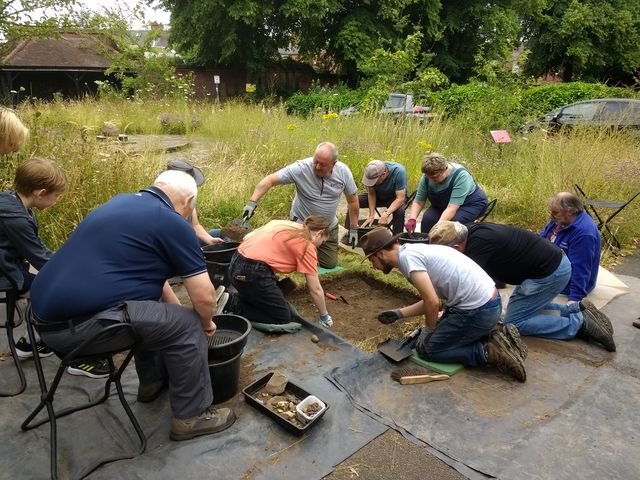


Test Pit No. 2 modern concrete supporting the kerb at left, edge of clay surface running top to bottom, possible traces of cobbled path/yard:


Families enjoying a free day out with sunshine and a glorious backdrop:


 One of our photogrammetry models:


16 Jun 2022

New Project Coming Soon


Fancy digging a medieval moated manor house? There's nothing left above ground (unlike the marvelous 'Little Moreton Hall' in the photo) but whatever remains, we aim to find it! Join Wolverhampton Archaeology Group and you could be part of this exciting new project which starts in just a few weeks time. Email for details:

wolverhampton-archaeology-group@gmail.com 


28 May 2022

A Privy and a Pigsty


 While some might shy away from looking into the toilet arrangements of people in the past, for archaeologists they're an especially interesting subject so the chance to investigate a 'privy' with no mains water connection is quite exciting.

Much has been written about Roman toilets, medieval garderobes and monastic latrines but there's surprisingly little detail about the period between the end of the medieval era and the advent of modern sanitation in the late 1800s. It's not hard to find references to cesspits, ash-pits and dust-holes but more is written about their nuisance than about their construction and use.

One of our current digs concerns that even rarer breed of 'necessarium'; the combined privy and pigsty. The toilet consisted of a bench-type seat mounted over a brick-built trough about 50cm deep. Waste would fall into the trough and ashes would be sprinkled on top with the final products of decomposition running through a small arch into an 'ash pit' which was also the receptacle for household waste and the contents of commodes. Now and then the cover would be taken off the ash-pit and the contents removed, either composted, strewn on nearby fields are taken away by a 'night-soil man'. The sketch shows what we think the building looked like and the photo below shows the 'trough' (left) and the ash-pit (right) with the connecting arch between.

Needless to say, the building was situated as far as possible from the house - probably not a trip you'd want to make in a rural location in the dead of night in mid-winter!


1 May 2022

Revisiting the Cistern


Today we revisited the soft-water cistern in the yard of our early 19th century cottage excavation. The aperture seems to have had a curve cut into it to allow easier access for cleaning. We also discovered that it was originally lined with pitch, some of which still clings to the brickwork and sandstone.


23 Apr 2022

Our Festival of Archaeology Dig


In the last week of July, during the Council for British Archaeology's 'Festival of Archaeology' week, we'll be carrying out an excavation on the lawn near the front door at Oak House in West Bromwich.

This iconic building dates from the early 1600s and to the best of our knowledge, there has not been any archaeological investigation at the front of the property. In 2020 we put in a small test pit at the rear of the property and after removing a century's worth of landscaping and rubbish, made some interesting finds, contemporary with the earliest days of the house.

While visitors to the house will be able to have a brief 'hands-on' archaeology session, we're also inviting volunteers to assist with the dig. Tasks will include digging with a spade, excavating with a trowel, sieving excavated material, cleaning finds etc. No experience or equipment is needed and there's no cost involved. Our public liability insurance means that we can only accept adult volunteers and each day will run from around 11am until 3pm from 26th to 28th July 2022. You can take part in one day or all three, as long as you can stay for the full session on your chosen day(s).

If you'd like to take part, please send an email to: wolverhampton-archaeology-group@gmail.com


29 Jan 2022

Albrighton Church Dig


It's not often archaeologists get the chance to dig right beside a church and have fair weather at the end of January to boot, so we were hopeful that this double helping of good fortune would extend to finds and features at today's dig. However, as does occasionally happen, our investigations proved somewhat disappointing.

It seems that the area where we were digging has been well disturbed - not unexpected given the proximity of the existing graves - and finds were few and far between. We did find many fragments of roof tile, of different types, some of which are no doubt from the 19th century rebuilding of the church, and a few pieces of chunky floor tile, one of which had traces of a glaze.

Two sherds of medieval 'sandy ware' pot came to light, both of which date from the 12th to 15th century or somewhere between 500 and 900 years old! One had a pale yellowish brown glaze that terminated halfway down the sherd, the other was un-glazed. Most surprising was that there was just one sherd of 19th or 20th century white pottery with no sign of the usual willow pattern or other common types and none of the usually ubiquitous clay pipes. A few small fragments of bone were found, most probably from early graves that had been disturbed long ago.

Probing revealed that the soil up to a metre below the bottom of our trench was very soft and no doubt much disturbed so the dig was terminated well before reaching the natural. A report will be published in due course and circulated to members of the Albrighton & District Historical Society, several of whose members joined us for today's dig.


20 Jan 2022

A BIG surprise


We were treated to a completely unexpected view at one of our on-going excavations when a small hole appeared in the bottom of one of our trenches. We were hoping to find the bore-hole for a domestic water pump which we knew was nearby but instead found a large circular rainwater cistern, measuring about 10ft in diameter and 8ft deep!

This photo shows the aperture after enlargement - the pump's down pipe (around 2" in diameter) can just be seen standing almost upright in the darkness below.


In the interest of safety for ourselves and others, we had the onerous task of filling in most of the tank but at least we know where it is if future investigation is required!

Before making it safe, we gingerly lowered a camera into the cistern and were greeted with some fantastic images. This one shows that the reservoir consists of courses of brickwork laid on top of a hollowed out sandstone base. The photo at the top of this article shows one of the massive sandstone slabs which cover the top of the cistern, sitting on the bricks.


24 Nov 2021

Cottage Floor Rediscovered


This quarry tile floor was laid just over 200 years ago and has been buried under a metre of rubble since the house was demolished around 1950. Little is known about the cottage itself and there are no known photographs. Thanks to WAG its floor plan and the methods used in the building's construction will soon be revealed and recorded for future generations.